Lab analyser integration — 50+ instruments and the protocols behind them.
If your instrument isn’t listed, send the model number and interface manual. Most new integrations take two to four weeks including on-site validation.
Send your instrument listEvery analyser has a settings page, a raw log and a live feed.
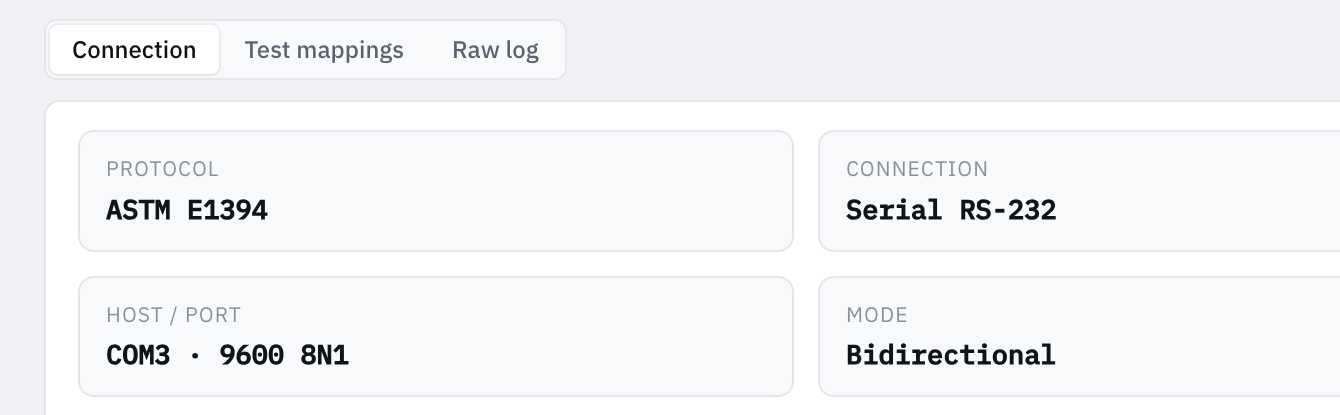
Protocol, port, encoding and verification policy are configuration per instrument — visible to your engineer, changeable without a release, with the raw message log one tab away.
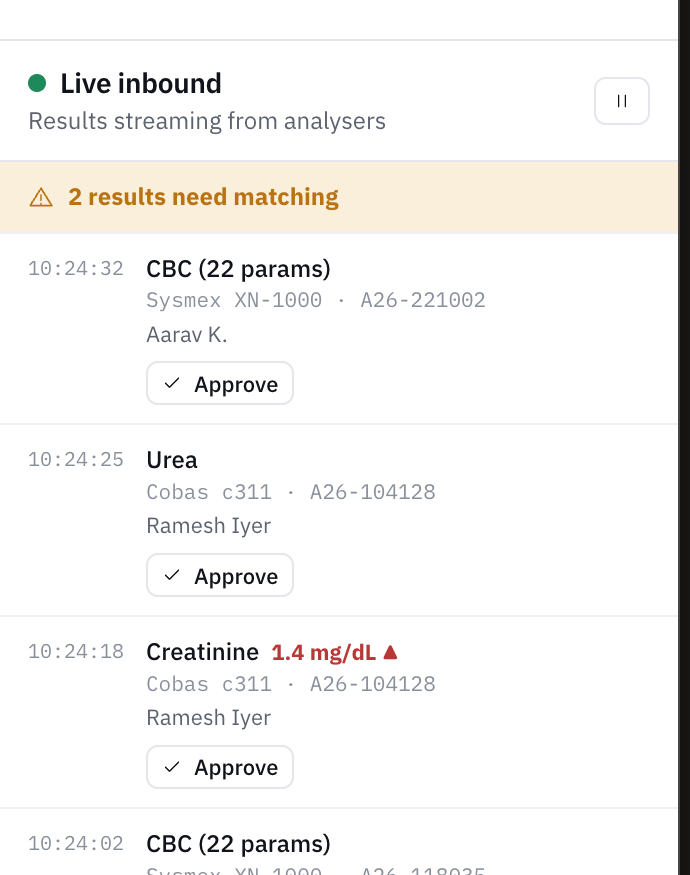
Results stream in as the analyser produces them, matched to the accession barcode. Anything that arrives without an order is held and flagged rather than silently filed.
Site audit
Every instrument listed with model, firmware and port availability.
Driver build
Interface manual mapped to our driver layer and unit tested.
Bench test
Sample runs against known controls, in our lab or yours.
Parallel run
Live alongside the existing process until results match.
Sign-off
Validation document handed to your quality team.
Analyser interfacing, answered.
Protocols, timelines and validation for laboratory machine integration.
What if our analyser isn’t on your supported list?
Send the model number and the interface manual. Most new instruments take two to four weeks to build, bench test and validate on site, and the driver becomes part of the platform for every lab after that.
Which interfacing protocols do you support?
HL7 v2.x ORM and ORU messaging, ASTM E1394 record transfer, ASTM E1381 link layer, CLSI LIS2-A2, direct RS-232 and TCP instrument links, and CSV, XML or shared-folder polling where a machine offers nothing better.
Is the integration bidirectional?
Where the analyser supports it, yes — worklist and order download to the instrument, result upload back to the case record, with flags preserved for out-of-range values.
Do you use third-party middleware?
No. We write the protocol-level driver ourselves, so when an analyser behaves oddly at 2am the person who wrote the interface is reachable.
What does on-site commissioning include?
Site audit of every instrument with model, firmware and port availability; driver build and bench test against known controls; a parallel run alongside your existing process; and a validation document handed to your quality team at sign-off.
Bring us your requirement. We’ll bring the expertise to make it real.
A 30-minute call with an engineer, not a salesperson. Tell us the problem and we’ll tell you what’s possible.